Your craft was never just a hobby
Podcast Transcript:
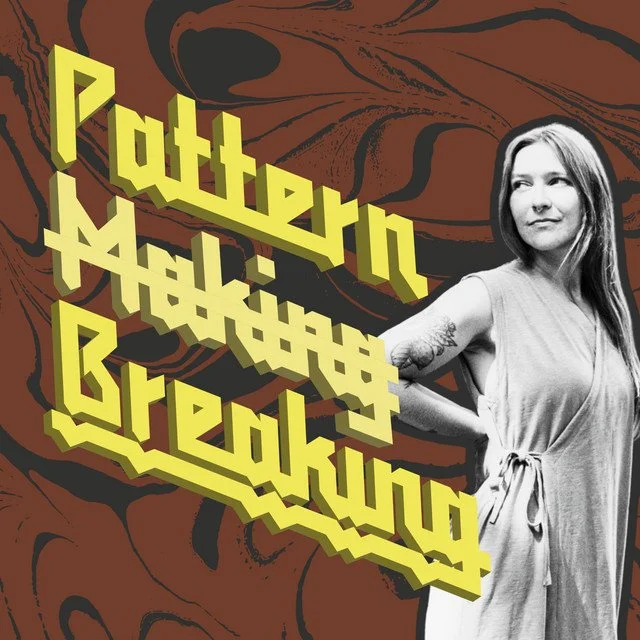
Hello and welcome to the Pattern Breaking Podcast. As soon as I started teaching technical pattern making, I immediately started to feel that my students needed support with more than just the technical stuff, more than just the numbers and the techniques and the rules and the rules of thumb and the best practices and all the
technical knowledge that goes into being a really good pattern maker. I had a place to teach that, but I immediately started to feel like I both needed and wanted to support my students with more than just that.
Because we’re whole humans. We’re not just technical processing brains. We are emotional. We have bodies that need to be cared for. We can overdo it and burn out and we can be hard on ourselves. And all of these things go into teaching real, full humans, holistically.
And this pattern breaking podcast is my place to start having those conversations, those bigger conversations that aren’t so technical, but are more subtle, emotional, energetic, and really creative.
So when I first started teaching technical pattern making, I started to feel that right away, right? That people needed support with more than just the technical stuff. People needed emotional support, to be perfectly honest. But I also started to feel that I wanted to be having conversations about how craft, especially textile craft, like sewing and knitting and crochet, is so important to who we are as humans.
Like,
creativity is so much more important than the surface-level hobby conversation that it’s treated as.
You know this. If you’re listening to this, you know this. You can feel how important your craft is to you. You can feel how it’s the thing that you want to do with your spare time. You can feel how satisfying it is to you to...
make beautiful things and enjoy them in your day-to-day life. You know how proud you feel when someone notices something that you’ve made and you get to tell them that you’ve made it. You know that this is like really deeply important to you. And I think of how for me and for so many of my students, we have like powerful memories of our mothers or our grandmothers and their love for their craft, like...
many of my students and it’s my own story as well, we have our mothers and our grandmothers who also sewed and knitted and crocheted. And for them, it was like a very important part of their lives. It was something that they wanted to hand down to us.
We can feel how much, like how important it was to them and how beautiful the connection is between us and our ancestors, right? That how craft connects us, how craft is like a lineage, how craft is something that doesn’t go out of style. And yet we blow it off like it’s a hobby. Like it’s something that if you spend money on it, like if you spend money on your hobby,
you should probably be a little bit ashamed of yourself, right? Have you done that? Have you spent money on fabric and been like, my gosh, I will never tell anybody how much I just spent on that. And it’s not about the money. It’s about that feeling of like, I shouldn’t be doing this. It’s about the feeling of like, no one would understand the importance of this to me.
No one would think that that was a good investment in myself, right? And yet, I want to tell you these stories about how at the end of our lives, we really will feel like that was the most important thing that we could have been doing. So my grandmother died a few years ago, and multiple times when I was spending time with her at the end of her life,
She, you I remember sitting in the cafe with her in like the diner that was her favorite here in, ⁓ in Ohio. And I remember her like holding out her hands, showing me her hands that had been reshaped by arthritis, you know, like the tips of her fingers were crooked and her knuckles were big and knobby. And, and she told me, I can’t crochet anymore. My hands just hurt too much. I can’t crochet anymore.
And she did this multiple times, like showing me her hands, reflecting on the fact that she wanted to be crocheting, that she had these hands and she wanted to be crocheting with them, but she couldn’t anymore.
And I told her, I remember telling her, was like, grandma, you crocheted more in your life in the time that you did crochet. You crocheted more than more people do in entire lifetimes, like in multiple lifetimes. And I told her, our houses, like all of the houses of all of your grandkids and great grandkids, like we all have your crochet stuff in our houses.
There’s so much of it and we just love it. Like it’s just, they’re treasures to us.
But she kept coming back to that. She kept feeling like if only I could spend this time that I still have making the things that I wanna be making. She hadn’t had enough, you know, at the end. She’s at the end of her life wishing that she could keep crocheting, keep creating more.
And it makes me think of all the people who look at my course, my Confident Pattern Making and Grading course, and tell themselves, no, I can’t spend that kind of money to study pattern making. It’s just not that important to me. It’s just my hobby. Like, I can’t spend that kind of money on a hobby. And yet, here’s my grandmother at the end of her life wishing.
that she had spent even more time than she already did on her hobby. Wishing that she could keep filling her days with making beautiful things, with feeling the yarn between her fingers, with feeling the satisfaction as that doily or that bedspread that she was making took shape in front of her eyes. That’s really how she wanted to her time until the end of her time.
We have these stashes, right? These stashes of closets full of fabric and yarn, but we’re like ashamed of them. It’s like, or we make jokes about them, like we should be ashamed of them. That it’s something that like to hide away, to like not let anybody know how much you actually have, like not let anybody know like how ambitious you were, you bought all this stuff thinking that you were gonna make something out of it, but like, know, life happened and like.
You should be ashamed of yourself. Just layering on all the shoulds and all the assumptions that that is somehow a poor use of your money and a poor use of your time when it’s just a ⁓ real tangible expression of how important this thing, this craft is to you.
So this happened again with my mom. My mom taught me how to sew back when I was in middle school. She’s always sewed, you know, she learned how to sew when she was a little kid and made us Halloween costumes when we were kids. And I remember when she taught me how to sew, you know, we would go to Joanne’s and like look through the pattern catalogs and pick out.
pick out a pattern and pick out fabric and she helped me put it together. So like she’s who taught me how to sew when I was little. And she really got into quilting about 20 years ago and has made hundreds of quilts and quilted projects like in that, you know, over those years. ⁓ And, you know, she has a ⁓ room in her house dedicated to it. She has a ⁓
big stash of fat quarters and yardage and all this stuff, all the equipment for quilting.
But she’s in her 70s and she has had strokes. So she had one about 10 years ago and was pretty much fully recovered from that. And then unfortunately she had one last October, which knocked her back quite a bit. And then she had one last month, another one. So two strokes and.
pretty quick succession and it has made it impossible for her to quilt. She just doesn’t have enough fine motor control dexterity to even to use a sewing machine and especially without running over her finger or especially with the precision that it takes to quilt.
And sure enough, like, I don’t think she ever, or maybe, you know, maybe she was influenced by her mother. This was my grandmother that I was speaking about earlier was, is her mom. She probably remembers my grandmother saying that, you know, about wishing that she could crochet more at the end of her life. But I don’t know how consciously my mom was holding that in her mind when she told me the other day that she, you know, she can’t.
And my mom now can, her voice is really soft. Like this most recent stroke has made it really hard for her to talk. She said to me, I can’t quilt anymore.
And she told me, it’s all right though, because I’ve made so many.
But you know, it’s the same thing where like life happens, like our abilities change over time. Like this is part of our lives.
And yet we guilt ourselves into thinking that spending time or money on our hobbies in our prime, in like the days where it’s what we want to do, it’s what we can do, it’s what we’re going to want to have done more of when we can’t anymore.
What if you started to treat your craft not like it’s just a hobby, but like it’s the thing that at the end of your life you’re going to want to have done even more than you already have?
Don’t put it off. Do the thing that makes your life feel more beautiful now for your own joy and satisfaction, but also because know that your craft literally makes the world more beautiful. Everybody that comes into contact with you, everybody that you share your craft with, their life is enriched.
more and you also give them permission to spend time on what feels important to them. That you give them permission to spend a little money to start a hobby, to take a class, to fill the spare bedroom with the stuff that may in somebody else’s eyes be something to be ashamed of.